

WHAT IS
HEART SOUND RECORDING?
Heart Sound Recording is a non-invasive educational wellness experience that uses specialized equipment to capture the sounds and rhythms produced by your heart.
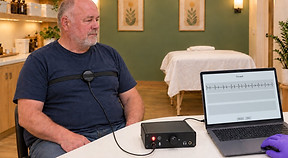
A small sensor is placed at four spots on the chest, one at a time, to record heart sounds. Those sounds are then displayed visually, allowing you to see the patterns created during the cardiac cycle.
Your heartbeat is something you've heard your entire life.
HSR gives you an opportunity to see it, too.


NON-INVASIVE
No needles or blood draw.
LISTEN
Specialized equipment records the sounds produced by your heart.
VISUALIZE
The recording transforms those sounds into a visual representation you can see.
YOUR HEART. VISUALIZED.
SEE YOUR HEART SOUND.
Heart sounds can be captured and displayed as waveforms, creating a visual representation of the sounds and rhythms occurring throughout the cardiac cycle.

THE RECORDING
Specialized equipment captures
the unique sounds of your heart.

THE WAVEFORM
The sounds are connected into waveforms, allowing you to see your heart's rhythms
and patterns.
THE EXPERIENCE
A comfortable 30-minute session focused on seeing and learning.
HEAR IT. SEE IT.
A real heart sound recording, shown as a moving waveform.
Turn your sound on and listen.
Example heart sound: “Liz’s heart at tricuspid” by EmilyHopeS, CC BY-SA 4.0. Historical images: Théobald Chartran (public domain) and Wellcome Collection (CC BY 4.0), via Wikimedia Commons.
WHAT HAPPENS DURING AN HSR EXPERIENCE?
01

CONNECT
A small sensor is placed at four spots on the chest to capture heart sounds.
02

RECORD
The HSR equipment records the sounds and rhythms produced by the heart.
03

VISUALIZE
The recording is displayed on a screen, allowing you to see the sound patterns and rhythms captured during the session.
04

LEARN
You'll have an opportunity to explore what you're seeing and become more curious about your own health and wellness.
Listen closer. Look deeper.
Learn something new.
BEFORE YOUR SESSION
No food for 2 hours beforehand.
No caffeine before your session.
Arrive 10 minutes early to relax.
Wear one thin layer of clothing.

EDUCATION. CURIOSITY. AWARENESS.
Heart Sound Recording is offered by Drop Focused as an educational wellness experience. It is not intended to diagnose heart disease or other medical conditions and does not replace an examination, diagnostic testing or advice from a licensed healthcare provider.
Our goal is simple: give you an opportunity to experience your body from a different perspective and encourage better questions, greater awareness and deeper curiosity about your health.
Knowledge.
Awareness.
Direction.
That's the focus.
CURIOUS? START HERE.
What is Heart Sound Recording?
Heart Sound Recording uses specialized equipment to capture and visually display sounds and rhythms produced by the heart.
What will I see?
The recorded heart sounds are displayed visually as waveforms or patterns, giving you an opportunity to see a representation of the sounds being captured.
Is HSR invasive?
No. HSR is non-invasive and uses a small sensor placed on the outside of the chest.
Does HSR diagnose heart conditions?
No. Drop Focused offers HSR as an educational wellness experience. It is not intended to diagnose disease or replace medical evaluation or diagnostic testing.
Does it hurt?
No needles or blood draws are required for an HSR recording.
How long does it take?
About 30 minutes, including a short intake, recording at four spots on the chest, a look at your waveforms on screen and time for questions.
Will I get recommendations?
No. Billie is the technician who records your heart sounds and shows you the waveforms. Supplements and all health suggestions come from your own holistic healthcare provider.
How should I prepare?
Skip food for 2 hours beforehand so digestion sounds stay quiet, and skip caffeine. Arrive about 10 minutes early to relax, and wear one thin layer of clothing.

CURIOUS?
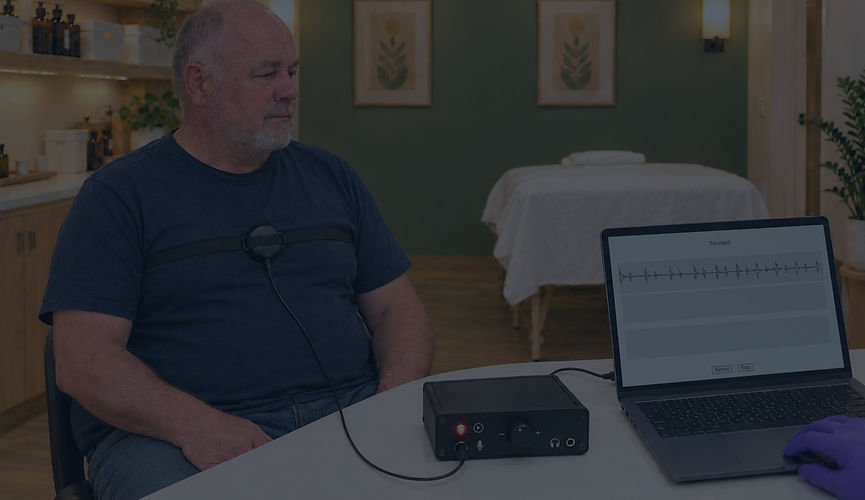
You’ve heard your heartbeat your whole life.
Come see what it looks like.
Drop Focused provides educational wellness experiences only. Heart Sound Recording (HSR) is not intended to diagnose, treat, cure or prevent disease and should not replace medical testing, diagnosis or treatment. Always consult a qualified healthcare provider regarding medical concerns.
Also from Drop Focused: Live & Dry Blood Auditing →